The Gwanju Uprising
18-27 may 1980
Beyond death, Beyond the darkness of age. May We Never Forget
A series of student lead demonstrations that took place in Gwanju, South Korea. The uprising was violently suppressed by the millitary.There is no universally accepted death toll for the Gwangju Massacre.it has been estimated to be anywhere between 1,000 and 2,000 people.
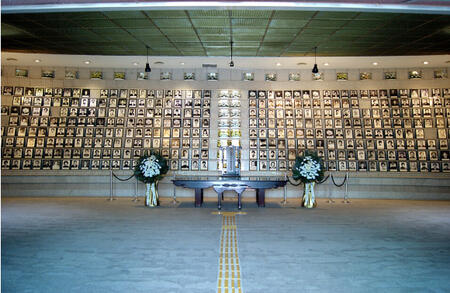
May 18 Memorial Park
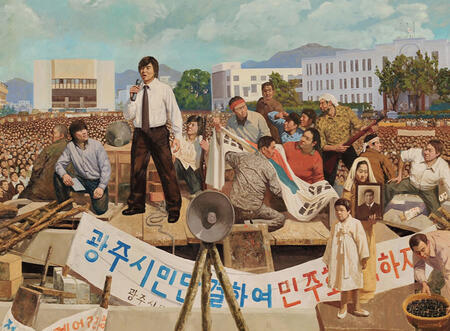
“End Martial Law!” Sacred Rally for National Democratization at the Fountain Plaza at the Old Jeonnam Province Hall.
*a quote from the book Gwangju Diary
Beyond Death, Beyond the Darkness of the Age, Lee Jae-eui 1985
THE EVENTS THAT LEAD TO THE UPRISING // history
The Assasination of Park Chung HeeBy the time of his assassination, Park had exercised dictatorial power over South Korea for nearly 18 years.On October 26 1979, South Korean President Park Chung Hee was assassinated by his own chief of state security.General Park’s assassination led to a power vacuum within the most powerful state institution of that time, the military.Park’s death also led to the ‘Seoul Spring’ (named after the 1968 Prague Spring) A short-lived period of student demonstrations calling for democratization.
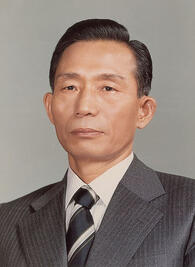
Park Chung Hee's Official Presidential Portrait, 1970
Chun Doo Hwan's Rise to PowerAfter the assasination of president Park Chung Hee, military group headed by Major General Chun Doo Hwan took the advantage of fragile political situation and by the spring of 1980 they had been able to seize control over both state and military affairs.He governed under a constitution less authoritarian than Park's Fourth Republic, but still held executive power, and used extreme violence to maintain it.After months of increasing public tension and protests for democracy, On May 17, 1980, Chun declared martial law over the country, closed universities and banned all public gatherings.key locations of protest like Seoul, Pusan-Masan, and Taegu ceased on the morning of May 18. it was just Gwanju that remained.
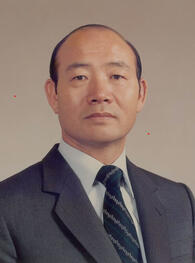
Chun Doo Hwan's Official Presidential Portrait, 1980
THE LASTING INFLUENCE OF THE UPRISING // effects
the road to democracy in South Korea was one paved with blood and the people's undying ambitions that burned bright in the darkness, until the very end.
Although it was unsuccessful, the Gwangju movement inspired further protests for democracy during the 1980s.Amid the nationwide protests, Roh Tae-woo, Chun's successor, announced a reform proposal.this lead to the establishment of a direct presidential election system.On December 16, 1987, the presidential election was held according to the new constitution, marking the inauguration of the Sixth Republic.
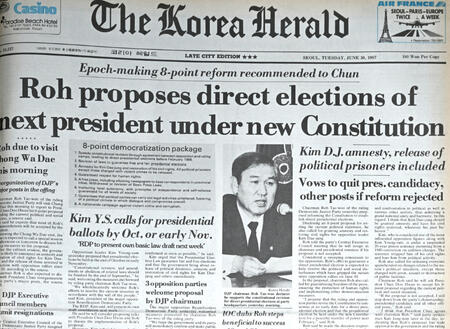
The Korean Herald announcing Roh's victory and his promises for democracy.
The Gwangju Uprising has become a symbol of South Koreans' struggle against authoritarian regimes and their fight for democracy
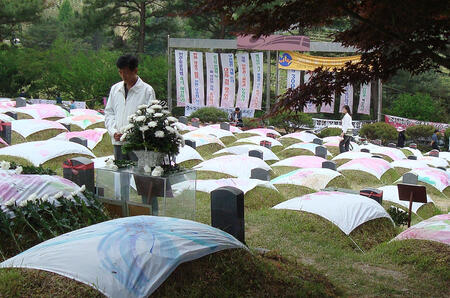
The victims of the Gwanju Uprising were buried at the May 18 national cemetery
THE TIMELINE OF THE UPRISING // conflict
It wasn't just an uprising. It was a massacre.
MAY 18
students gathered at the gate of Chonnam National University to protest its closing due to the martial law.by 4 pm, paratroopers from the Republic of Korea Special Warfare Command (ROK-SWC) took over as protester numbers grew to over 2000.The violent suppression of the protests by the ROK-SWC led the number of protesters to rapidly increase, exceeding 10,000 by 20 MayMAY 20
As the conflict escalated, the army opened fire on the citizens, killing an unknown number of protesters near Gwangju Station.MAY 21
gun fights had broken out between civilian militia and the army in the Provincial Office Square. This forced the army to retreat and Gwanju was "liberated" temporarily.
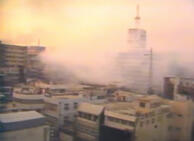
Gwanju on fire at the height of the fighting. (CBS NEWS screenshot)
MAY 22-25
During the brief liberation period, The Citizens' Settlement Committee and the Students' Settlement Committee were formed.they took charge of funerals, public campaigns, traffic control, withdrawal of weapons, and medical aid. as well as unsuccessful negotiations with the army.MAY 26
The army was ready to reenter Gwangju. Following news of the imminent attack, civil militias gathered in the Provincial Office and made preparations to make a last stand.
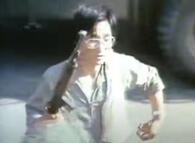
A Gwanju citizen arming themselves to fight the army (CBS NEWS screenshot)
MAY 27
In the early hours of may 27 1980, Chun's military forces unleashed armoured tanks, personnel carriers and helicopters over the city.They attacked and killed indiscriminately.The Gwanju Uprising that had lasted 8 days, was crushed in a matter of 2 hours.
BIBLIOGRAPHYLee, Jae-eui, 1985, Gwangju Diary: Beyond Death, Beyond the Darkness of the Age, the English translation by Seol Kap Su and Nick Mamatas. available from https://files.libcom.org/files/Gwangju%20diary%20resized-compressed.pdf
[accessed 2/6/25]Han, Chong-suk, 2017, Britannica, Gwanju Uprising available from https://www.britannica.com/event/Gwangju-Uprising
[accessed 2/6/25]Jae-eui Lee, Jeong Yong Ho, Hwang Sok Young. 1985. Translated by Slin Jung Adapted from the book Gwanju Uprising: The Rebellion For Democracy. Can be found at: https://jacobin.com/2022/10/south-korea-student-protests-gwangju-democracy
[accessed 8/6/25]Se Young Jang, 2017. The Gwanju Uprising, battle over South Korea's History. Can be found at: https://www.wilsoncenter.org/blog-post/the-gwangju-uprising-battle-over-south-koreas-history
[accessed 10/6/25]Sheena Choi, 2015. Protesting Identity: Memories of the Kwangju Uprising and Effects on Identity Formation of Youths. Can be found at: https://files.eric.ed.gov/fulltext/EJ1088346.pdf
[accessed 10/6/25]Darry Plunk. 1985. South Korea's Gwanju Incident: Revisited https://www.heritage.org/report/south-koreas-kwangju-incident-revisited
can find pdf of transcript on website.
[accessed 10/6/25]Jung Dae-ha, Kim Kyu-nam and Lee Jeong-gyu. 2019. Chun Doo-hwan arrived in Gwangju by helicopter before troops opened fire on civilians. can be found at http://english.hani.co.kr/arti/englishedition/enational/893879.html
[accessed 12/6/25]
NATIONAL HISTORY CHALLENGE 2025- Shuangyi Wu (Maisy)